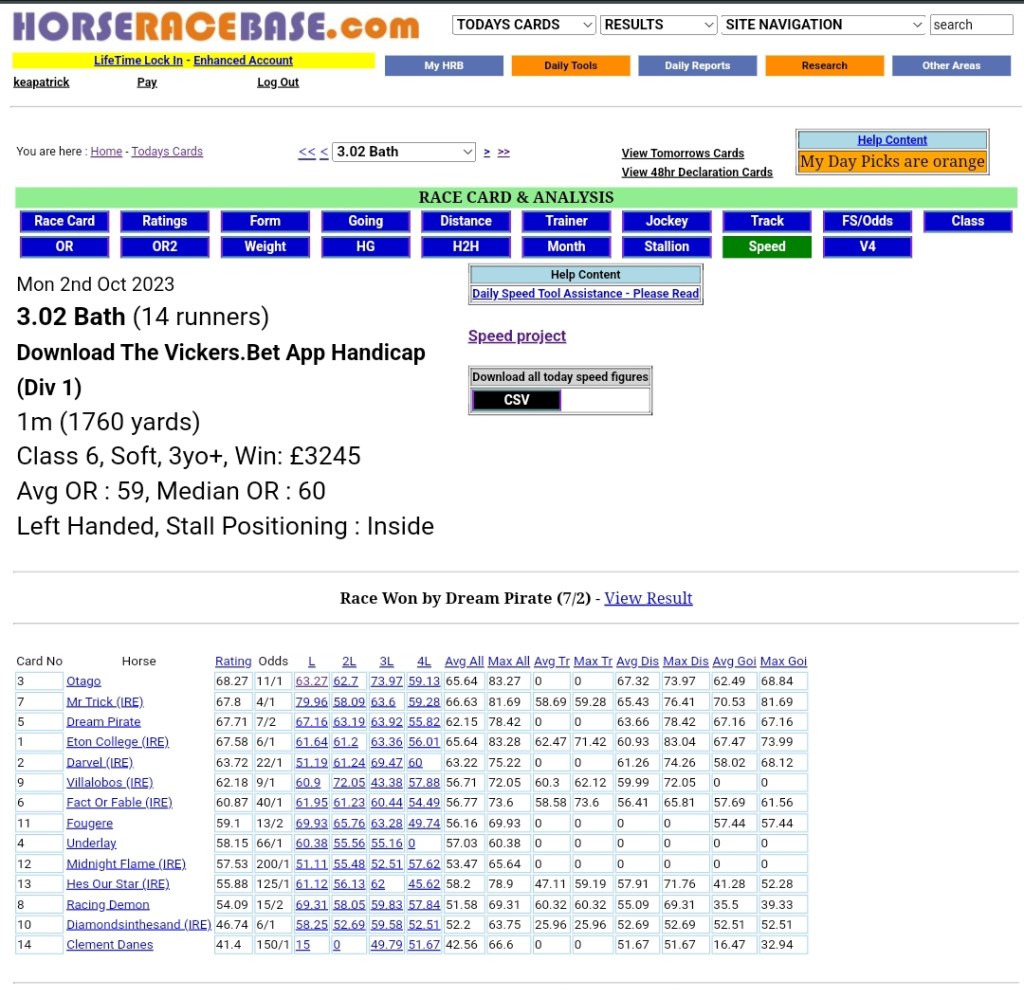
Speed ratings provide a numerical representation of a horse’s performance, factoring in the time taken for a race relative to the distance. When utilized effectively, these can offer an edge in handicapping races. Here are steps on how to use the provided speed ratings in a productive and logical manner:
- Understand the Components:
- Rating: An overall speed score for the horse based on recent performances.
- Odds: The odds at which the horse is expected to win.
- L, 2L, 3L, 4L: Speed scores for the last four races.
- Avg All, Max All: The average and maximum speed scores over all races.
- Avg Tr, Max Tr: Average and maximum speed scores at this track.
- Avg Dis, Max Dis: Average and maximum speed scores at this distance.
- Avg Goi, Max Goi: Average and maximum speed scores on this type of going (track surface).
- Analyse Recent Form:
- Prioritise horses with consistently high ratings in their last few races (L, 2L, 3L, 4L). This indicates current good form.
- Consider Track & Distance:
- If a horse has performed exceptionally well at the same track (Avg Tr, Max Tr) or over the same distance (Avg Dis, Max Dis) previously, it can be a good indicator of potential success in the upcoming race.
- Factor in Overall Speed:
- The Avg All and Max All figures give an idea of the horse’s consistent performance and peak performance respectively. A horse with a higher average speed rating over all races is generally a more reliable pick.
- Odds as a Guideline:
- While not directly related to speed ratings, odds provide insight into public opinion. Horses with lower odds are generally considered stronger contenders. However, don’t just follow the crowd. Sometimes, a horse with a good speed rating might be overlooked in the betting market, offering value.
- Check Outliers:
- If there’s a horse with a single outstanding speed figure compared to others, investigate why. It might be due to a particularly good (or bad) day or an anomaly.
- Consistency Matters:
- A horse with consistent speed ratings is generally more reliable than one with fluctuating ratings. A horse with scores of 60,61,62,63 is more reliable than a horse with scores of 50,70,50,70, even if their averages are the same.
- Cross-reference with Other Information:
- Speed ratings are just one tool. Cross-reference with other data like trainer/jockey combinations, horse’s pedigree, weight carried, and other factors.
- Practice & Review:
- Begin by paper trading or betting small amounts. After the race, review the results and analyse where the speed ratings were accurate and where they weren’t. This helps refine your approach over time.
- Keep Records:
- Maintain a log of your selections and outcomes. This helps in identifying patterns, understanding which kind of races or horses you’re more successful with, and refining your strategy.
Lastly, remember no tool or strategy guarantees success in horse racing. Speed ratings are an analytical tool, but horse racing also has many unpredictable elements. It’s crucial to use them as part of a broader strategy rather than a definitive guide.
 TimeWise Chronicles
Leave a comment