In racing analysis, few metrics seem more objective than the race time. A stopwatch doesn’t lie — or does it?
When used properly, race times and going allowances can offer powerful insight into how a race unfolded, how good the winner really was, and whether a performance was flattered or undercut by circumstances. But like all stats in racing, context is crucial.
Two races this season — the 2025 Epsom Derby and Oaks — offer a timely reminder that interpreting race times in isolation can mislead unless you’re also factoring in pace, ground, rail movements, and the standard time for the track and trip.
—
📉 What Are Going Allowances?
A going allowance is a figure used to account for how fast or slow the ground is riding compared to expected norms. It’s commonly measured in seconds per furlong and used by Timeform, Racing Post Ratings (RPR), and private handicappers to adjust race times back to a par level — producing speed figures or performance ratings.
In essence:
Faster ground (Good to Firm) = lower or even negative allowance (i.e., quick conditions)
Softer ground (Soft, Heavy) = higher positive allowance (i.e., slower surface)
But here’s the catch: the same official going description can result in very different going allowances depending on pace, wind, rail position, and how the race was run.
—
🧪 2025 Derby vs Oaks: A Case Study
Let’s look at the raw times and the calculated standard times from HorseRaceBase, based on a 3yo-only median model for 1m4f at Epsom using rounded distances:
Race Date Going (Official) Win Time (s) Standard Time (s) Diff (s)
Derby 7 June 2025 Good 158.50 156.97 +1.53
Oaks 6 June 2025 Good to Soft 158.91 158.70 +0.21
At first glance, you might assume the Derby was only marginally slower — but look closer, and the raw difference from par tells a more interesting story.
—
🧠 What This Really Tells Us
🔹 The Derby (+1.53s slower than par)
Despite “Good” going, the race was run over 1.5 seconds slower than standard, suggesting:
A steady early gallop
Perhaps no one committed early due to the pace-dictating nature of Epsom’s cambered bends
In terms of performance ratings, this dampens the visual impact of a wide-margin win unless adjusted via sectional analysis
🔹 The Oaks (+0.21s slower than par)
“Good to Soft” was declared, and the time was almost bang on par
This implies the fillies’ race was run more evenly — a truer test despite softer ground
The winner’s time could be underrated if judged purely against the Derby performance the next day
—
🎛️ Why Context Is Everything
Times alone don’t explain why a race was slow or fast. Here’s what can distort interpretation:
Pace shape: A slow early gallop produces falsely slow times. Horses sprint home, but final time lags.
Wind: A strong headwind in the straight can knock seconds off without any visible ground change.
Rail movement: A race run with rails out might be longer than the published trip — another hidden factor.
Ground inconsistency: “Good” can vary widely by track. Timeform often publishes a more accurate, time-based going (and in 2025, they rated the Derby as closer to Good to Soft based on final times).
—
🧭 Conclusion: Adjusting the Lens
For serious punters, handicappers, and students of form, race times and going allowances are essential tools — but only when used in context. Without understanding pace, par standards, and race dynamics, you risk misjudging a slow time as a poor effort, or a fast one as top class.
In the case of the 2025 Derby and Oaks, it’s fair to say:
The Oaks was the truer stamina test, despite softer going
The Derby winner may have more in hand than the bare time — but that will only become clear with sectionals and deeper scrutiny
So next time you hear a horse was “slow by time,” ask: slow compared to what? And more importantly, why?
The last 50 3yo races at Epsom over 12 furlongs ⏱️👇
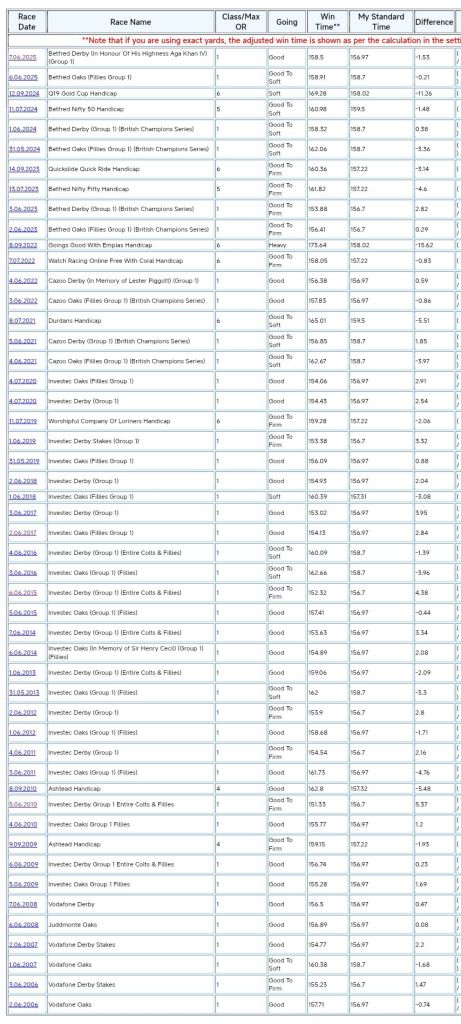
🕰️ When Time Tells the Truth: Why the 2010 Derby Still Stands Tall
In an era where race times are often ignored, misunderstood, or skewed by soft pace and misleading ground descriptions, the 2010 Derby stands as a beacon of clarity. A classic that didn’t just pass the eye test — it obliterated the clock.
🏇 2010: A Derby That Broke the Clock
Final time: 2m 31.33s
Going: Officially Good to Firm
Distance: 1m 4f 10y
Standard time (using median from HRB 3yo-only filter): 156.7s (≈ 2m 36.7s)
That means Workforce ran over 5.3 seconds faster than standard, smashing Lammtarra’s longstanding track record in the process — a mark that had stood for 15 years.
In length terms? That’s around 26 to 30 lengths faster than the standard for top-class 3yo races at Epsom. It wasn’t just good — it was generational.
—
🔍 Why It Still Matters
Many Derby winners are rated on visual impact, but few pass such a brutally honest time test. Fast times at Epsom are rare due to:
Undulating topography
Cambered turns
Tactical riding
Rail movements and watering policies
Yet in 2010, there was genuine pace (thanks to At First Sight, ironically intended as a pacemaker), fast ground, and a colt in Workforce who:
Was held up early
Made up several lengths in a matter of strides
Pulled clear with ease in the final furlong
The pace scenario and track position allowed for a strong-run, almost perfectly even-effort race — ideal for testing true class and stamina.
—
🧠 Compare That to 2025
Let’s look at the recent 2025 Derby:
Year Race Going Win Time Standard Diff
2010 Derby Gd/Firm 151.33s 156.7s -5.37s
2025 Derby Good 158.50s 156.97s +1.53s
2025 Oaks Gd/Soft 158.91s 158.70s +0.21s
The 2025 winners were both visually impressive — but neither race was run particularly fast. The Derby was over 7 seconds slower than Workforce’s, which suggests a steadier early pace or perhaps more holding ground than described.
That’s not to knock the modern performances — but it does show how race context and pace shape can either reveal or conceal true ability.
—
💡 The Lesson
Too often, we rely on race replays or betting SPs to define quality. But when a horse does something historically significant on the clock, it demands respect.
The 2010 Derby:
Featured a genuine gallop
Was run on true fast ground
Delivered a clear, no-excuses time that still stacks up 15 years later.
 TimeWise Chronicles
Leave a comment