A Review of Integrity, Interference and Hidden Form (10–16 January 2026)
Week in Context
The second full week of January marked a pivotal phase of the British racing season. Deep-winter National Hunt fixtures tested stamina and soundness on soft and heavy ground, while the All-Weather Championships continued to gather pace, sharpening the focus on tactical speed, draw position and surface suitability.
On paper, the week’s results were routine. In reality, the British Horseracing Authority’s Stewards’ Reports revealed a far richer layer of information. Integrity inquiries, veterinary flags and multiple high-impact interference incidents combined to distort the raw form. This review strips away the headline results to identify horses whose true performance was compromised, stables under short-term scrutiny, and patterns worth exploiting in the coming weeks.
Integrity and Regulatory Overview
Market Rasen: Stable Scrutiny Intensifies
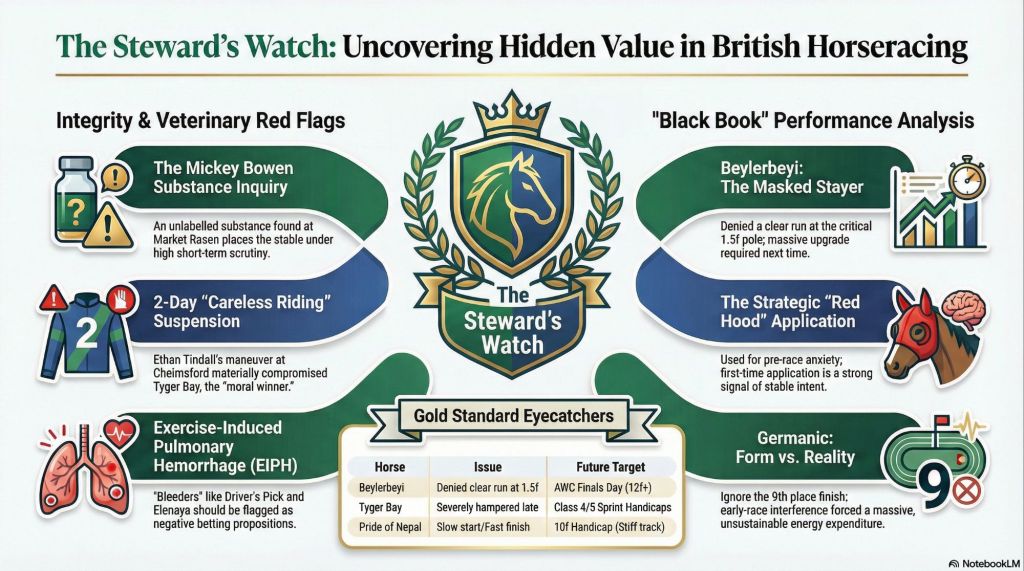
The most significant integrity issue arose at Market Rasen on 16 January, when an unlabelled substance was discovered in the care of trainer Mickey Bowen. While the Stewards accepted that no administration had taken place and allowed Hudson and Stratagem to run, the incident triggered confiscation, sampling and forensic analysis.
Key takeaway:
Although no immediate sanctions were applied, the Bowen yard now operates under heightened scrutiny. Experience suggests that stables under investigation often suffer a short-term dip in performance due to disruption and internal tightening of procedures. Until the substance analysis is concluded, Bowen runners should be treated with caution, particularly in competitive handicaps.
Administrative Error, Strategic Clue
At Lingfield on 12 January, Mark Usher was fined for doubly declaring Arlecchino’s Rex at both Lingfield and Wolverhampton. The horse ultimately ran at Wolverhampton.
Why it matters:
The decision hints at a clear surface preference. Wolverhampton’s Tapeta places greater emphasis on stamina and rhythm than Lingfield’s sharper Polytrack. This choice strongly suggests Arlecchino’s Rex is better suited to galloping all-weather tracks such as Wolverhampton and Newcastle, a useful angle for future placement.
Riding Standards and Hidden Winners
Chelmsford: The Tyger Bay Incident
Ethan Tindall’s two-day suspension for careless riding at Chelmsford had a material impact on the race outcome. His manoeuvre forced Tyger Bay to check sharply in the closing stages of a sprint where momentum is everything.
Form view:
Tyger Bay’s second place is far better than it appears. He lost winning momentum at a critical point and can be marked up significantly. This was a textbook “moral winner” and one to keep firmly onside next time.
All-Weather Championships: Performances in Disguise
Beylerbeyi – The Masked Stayer
In the Newcastle Middle Distance Trial, Beylerbeyi was denied a clear run from 1½ furlongs out – the key acceleration zone on the Tapeta. For a proven stayer dropping in trip, this was race-ending interference.
Despite that, he finished strongly into third.
Verdict:
This was an ideal prep run hidden by bad luck. His handicap mark remains intact and he looks primed for a major target over further. Expect a peak performance when returned to 12 furlongs or beyond.
Germanic – Ignore the Finish
Germanic’s ninth place in the Sprint Trial tells the wrong story. Early interference immediately after the gates forced him to expend significant energy recovering position. Unsurprisingly, he faded late.
Key signal:
The use of a Red Hood worked — he travelled smoothly mid-race. With a clean break and reasonable draw, he is capable of reversing this form entirely. The market is likely to overreact to the finishing position.
Rogue Supremacy – Victim of Circumstance
Bumped at the start and trapped in midfield, Rogue Supremacy never had the race run to suit. His hold-up style leaves him vulnerable to traffic, but it also keeps his mark in check.
Watchlist angle:
Well suited to a strongly-run 0–85 handicap where a clear passage can unlock his turn of foot.
Veterinary and Equipment Signals
Bleeders and Cardiac Issues
Several horses were reported to have bled from the nose, including Elenaya and Driver’s Pick. In UK racing, where race-day medication is prohibited, these are serious negative indicators.
Rule of thumb:
Horses returning from EIPH episodes are statistically vulnerable first time back. Both should be treated as lay-off risks.
Kenobi’s irregular heartbeat at Hereford is even more concerning and places him firmly in the high-risk category until proven otherwise.
The Rise of the Red Hood
The increasing use of Red Hoods during the week is noteworthy. Trainers are clearly placing greater emphasis on managing pre-race anxiety and conserving early energy.
Punters’ angle:
First-time Red Hood usage is often a positive intent signal. It suggests the stable is actively addressing a known limitation rather than hoping for improvement by chance.
The Black Book – Horses to Follow
Based on stewarding evidence rather than finishing positions, the following horses emerge as strong future winners:
Beylerbeyi – Clear-run away from a big performance over further
Tyger Bay – Momentum-killed at Chelmsford; sprint winner in waiting
Germanic – Result misleading; start interference decisive
Pride Of Nepal – Did far too much wrong early at Lingfield
Robusto – Tough, squeezed, and still competitive
Final Word
This was a week where the Stewards’ Reports mattered more than the results. Integrity scrutiny, tactical interference and veterinary disclosures combined to obscure genuine ability. Those prepared to look beyond the bare form now hold a significant edge as the winter season unfolds and the All-Weather Championships reach their peak.
 TimeWise Chronicles
Leave a comment