Creating your own fair odds tissue is one of the most useful habits a bettor can develop. Instead of asking “who will win?”, the question becomes “what price should each horse be?”. Once you know that, finding value becomes straightforward.
HorseRaceBase (HRB) makes this process much easier because its ratings already combine several key factors such as recent form, speed, horse ability, jockey, trainer and conditions.
Below is a simple, repeatable way to build a tissue using the TimeWise AW ratings.
Step 1 — Rank the horses by Total Rating
Start with the Total column in the ratings table. This gives an overall performance score based on multiple variables.
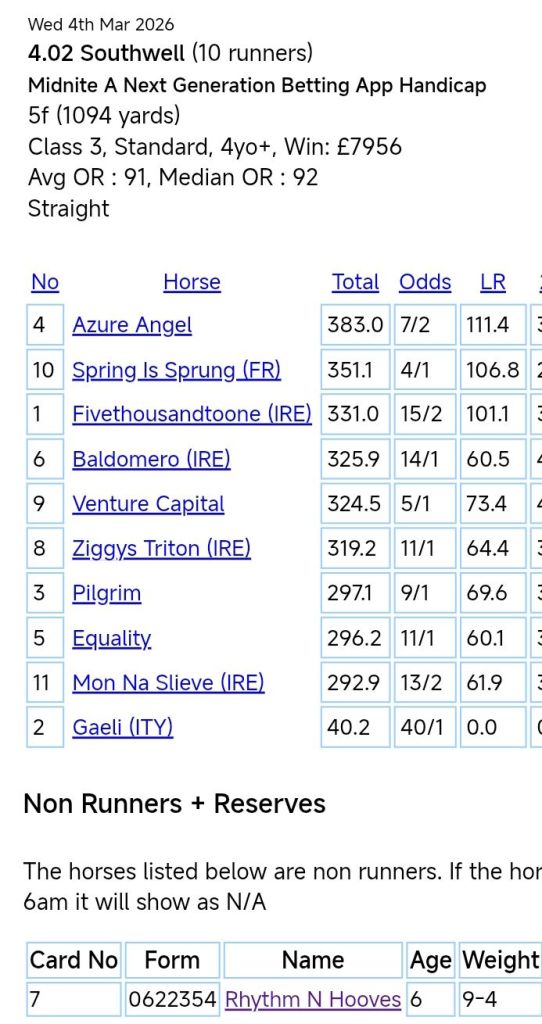
For the 4.02 Southwell, the rankings were:
Rank
Horse
Total
1
Azure Angel
383
2
Spring Is Sprung
351
3
Fivethousandtoone
331
4
Baldomero
326
5
Venture Capital
324
6
Ziggys Triton
319
7
Pilgrim
297
8
Equality
296
9
Mon Na Slieve
293
10
Gaeli
40
This ranking forms the foundation of the tissue.
Step 2 — Use historical strike rates
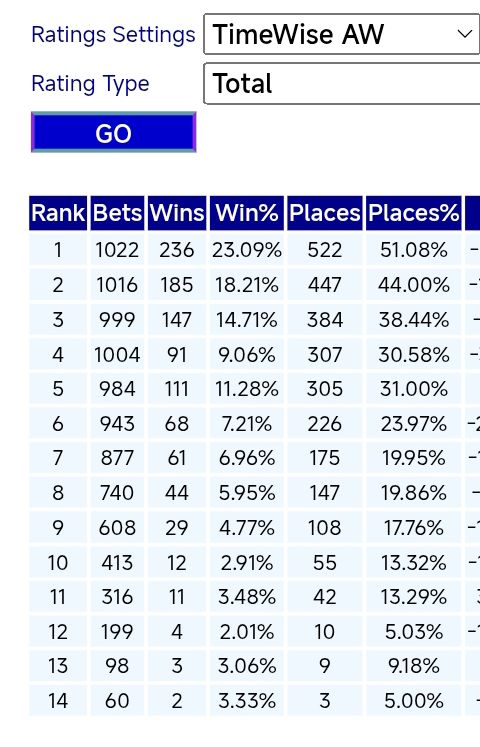
HRB allows you to test how well these ratings perform historically. In All-Weather handicaps, the TimeWise ranks produce the following win percentages:
Rank
Win %
Fair Odds
1
23%
4.3
2
18%
5.5
3
15%
6.7
4
9%
11
5
11%
9
6
7%
14
7
7%
14
8
6%
17
9
5%
20
10
3%
33
These figures effectively tell us how often each rank wins historically.
By assigning these probabilities to the ranked horses, we immediately have a baseline fair odds line.
Step 3 — Build the tissue
Applying those percentages to the Southwell race gives:
Horse
Rank
Fair Odds
Azure Angel
1
4.3
Spring Is Sprung
2
5.5
Fivethousandtoone
3
6.7
Venture Capital
5
9
Baldomero
4
11
Ziggys Triton
6
14
Pilgrim
7
14
Equality
8
17
Mon Na Slieve
9
20
Gaeli
10
33
This is your true odds estimate based on the ratings’ long-term performance.
Step 4 — Sanity check with component ratings
The Total rating already blends several elements, but a quick look at the underlying components can confirm whether the ranking makes sense.
Key components include:
Last Race (LR) – recent performance level
Horse rating (Hrs) – overall ability
Speed (Spd) – historical speed figures
Jockey / Trainer ratings – current connections form
Stallion rating (Stn) – breeding suitability for conditions
Today rating (Tdy) – how well the horse fits today’s conditions
In this race:
Azure Angel topped the Total rating and also had the strongest Last Race figure, reinforcing its position at the head of the market.
Spring Is Sprung had the highest jockey rating, supporting its place near the top.
Baldomero, while slightly weaker on LR, remained close in overall ratings, suggesting its large market price might be too big.
These checks ensure the rating ranks are logical, but they should not replace the probability framework.
Step 5 — Compare with the market
Once the tissue is built, the final step is simply comparing your odds vs bookmaker odds.
For example:
Horse
Market Odds
Fair Odds
View
Azure Angel
3.3
4.3
Slightly short
Spring Is Sprung
4.5
5.5
Slightly short
Baldomero
16
11
Value
Mon Na Slieve
6.5
20
Overbet
From this comparison the value opportunity becomes clear.
Rather than guessing winners, the focus becomes identifying prices that are bigger than their true probability.
Why this method works
This approach works well because it:
Uses large historical datasets rather than intuition
Converts ratings into actual probabilities
Keeps analysis consistent across races
Most importantly, it reframes betting from prediction to pricing.
Final thoughts
HRB provides powerful ratings, but the real edge comes from turning those ratings into prices.
By:
Ranking horses using the Total rating
Applying historical win percentages
Converting those probabilities into odds
Comparing with the market
you can quickly build a structured fair odds tissue for any race.
Once you start thinking this way, the game changes — you’re no longer trying to guess the winner, you’re simply asking:
“Is the market offering a better price than the horse’s true chance?”
And over time, that’s where the long-term edge lies.
 TimeWise Chronicles
Leave a comment