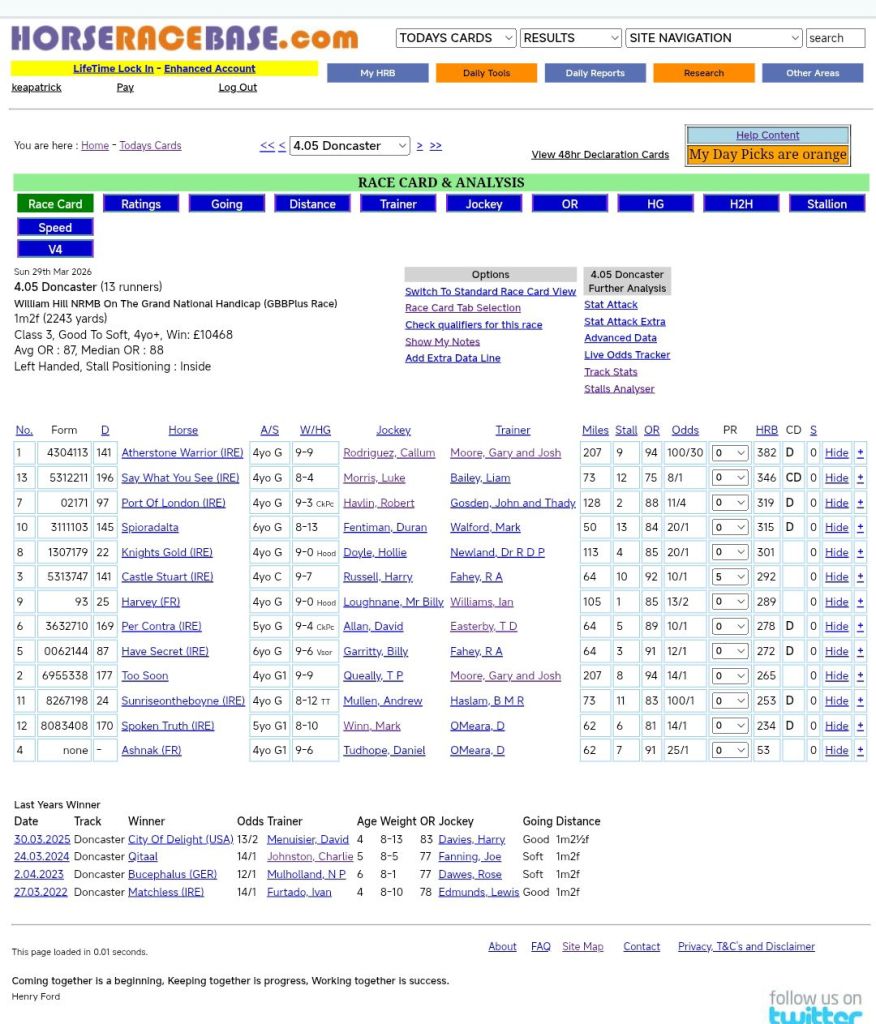
HorseRaceBase — using the racecard properly
Most people open the HRB racecard, glance at a few numbers, then still bet on instinct. That defeats the point. The racecard is built to structure your thinking. Used properly, it stops you guessing and forces you to make decisions based on evidence.
Here’s how to use it without overcomplicating things.
Start with the race, not the horses
Before you look at any runner, understand what the race demands.
Class level tells you how competitive it is
Distance and going tell you what type of horse is suited
Field size hints at pace pressure
If you don’t define the race first, you’ll end up fitting horses to a narrative instead of matching them to conditions.
Use the ratings to create a shortlist
The HRB ratings screen is not there to pick winners. It’s there to rank the field.
You’re looking for:
Clear top tier vs the rest
Tight clusters (competitive race)
Gaps (potential class edge)
Ignore the temptation to back the top-rated blindly. The value is in spotting when the market disagrees with the ratings.
Check suitability — not just ability
A horse can be well rated and still be wrong for the race.
Use the profiling tabs to answer three questions:
Has it handled the going?
Has it performed at the distance?
Is the sample size meaningful?
Small samples can mislead. Large samples with poor strike rates tell you the ceiling. The aim is to find horses that are both capable and suited.
Bring in speed figures for context
Speed figures tell you who can actually run.
They are useful for:
Identifying the raw pace in the race
Spotting horses with a higher ceiling
Highlighting inconsistency (big spikes vs steady figures)
But speed alone doesn’t win handicaps. It has to be usable within the race setup.
Factor in draw — but don’t overplay it
The stalls analyser shows historical bias, not certainty.
Use it to:
Spot general advantages (low, middle, high)
Support or question your shortlist
Then combine it with pace. Draw without pace is weak. Draw aligned with pace is where the edge sits.
Always bring it back to pace and positioning
This is where races are actually decided.
Once you’ve used HRB to filter the field, ask:
Who leads?
Who tracks?
Who is relying on a collapse?
Then match that against:
Draw
Distance
Ground
The best horse on paper doesn’t always win. The best positioned one often does.
Avoid the common traps
Don’t treat any single screen as the answer
Don’t overfit data to justify a bet
Don’t ignore context (class, pace, conditions)
Don’t chase “perfect profiles” — they rarely exist
HRB gives you tools, not certainty.
A clean workflow that actually works
Define the race (class, trip, going)
Shortlist using ratings
Remove those not suited by conditions
Check speed for raw ability
Factor in draw
Decide based on pace and positioning
That’s it. No noise.
Bottom line
HorseRaceBase is powerful because it forces structure. If you use it properly, you stop guessing and start filtering.
The edge doesn’t come from one number or one angle. It comes from stacking small, logical advantages and then having the discipline to act only when they line up.
Anything else is just dressed-up guessing.
 TimeWise Chronicles
Leave a comment